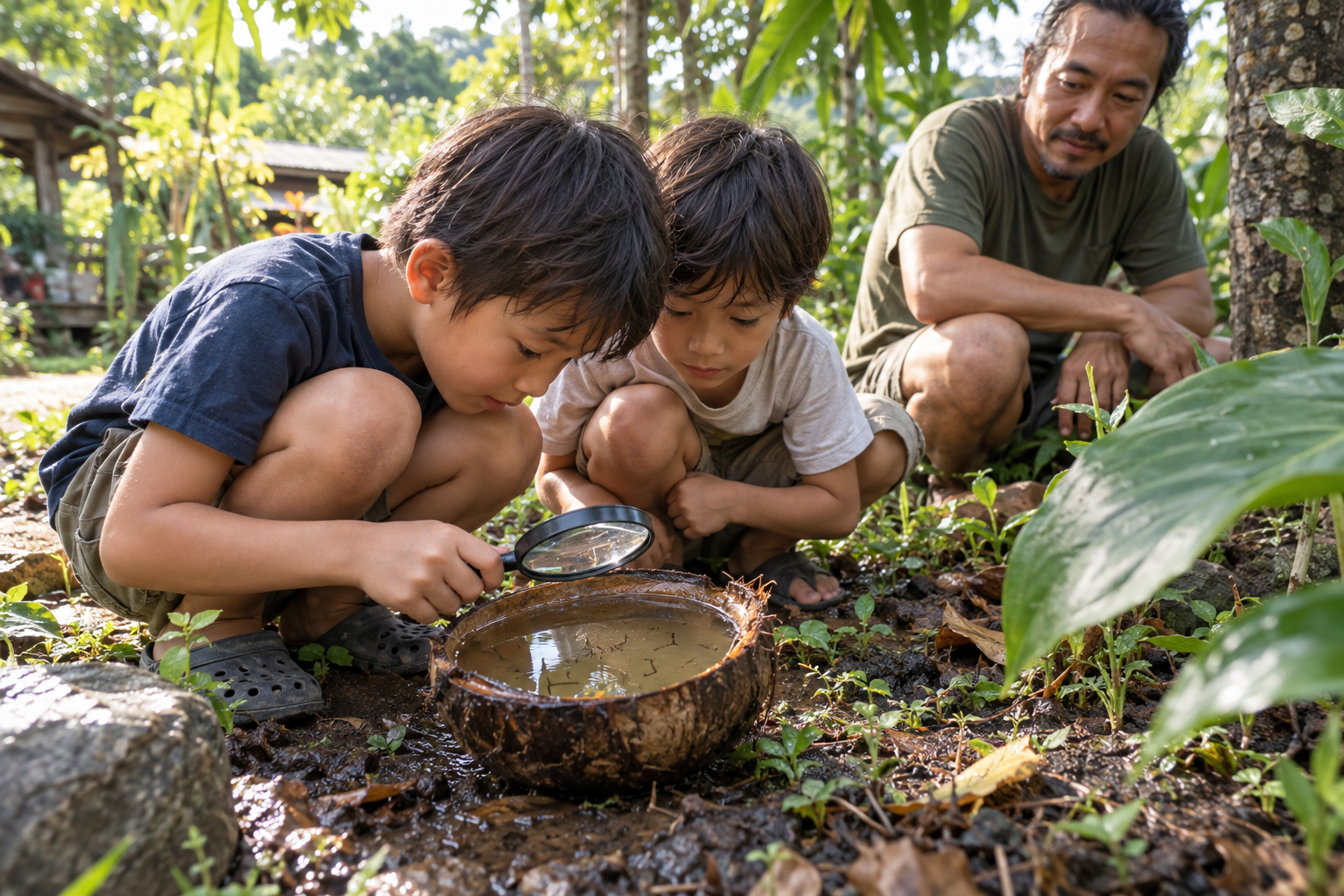
One morning, during a Learning of Life mission, we found mosquito larvae moving in a little pool of rainwater.
I could have explained immediately what they were. I could have talked about eggs, larvae, pupae and adult mosquitoes. I could have found a diagram, played a video and turned the moment into a biology lesson.
Instead, we watched.
The children noticed that the larvae kept wriggling back to the surface. Then they dropped down again. A few seconds later, they returned.
“Why do they keep coming up?” I asked.
The guesses began. Maybe they were eating something on the surface. Maybe they were trying to escape. Maybe they needed sunlight. Maybe they needed air.
Now the children wanted to know.
The explanation had somewhere to land.
Information is not yet learning
Adults are surrounded by explanations. Books explain. Teachers explain. Videos explain. AI can now explain almost anything, instantly and patiently.
But receiving an explanation is not the same as learning.
I can tell a child ten facts about mosquitoes and watch those facts disappear by lunchtime. Or I can help the child notice one strange thing, make a prediction and feel a real need to understand. The explanation may be shorter, but it is more likely to stay.
The difference is not the quality of the information. The difference is the state of the learner.
When children are already wondering, comparing, predicting or trying to solve something, their minds are active. New information is no longer an isolated fact. It becomes an answer to a question they already own.
This is why I have become careful about explaining too soon.
An early explanation can be helpful, but it can also close a door. The adult names the problem, supplies the method and gives the answer before the child has had time to look, struggle or become curious.
We save time, perhaps. But sometimes we also remove the reason to think.
This is not an argument against teaching
Children do not need to rediscover the whole of human knowledge by themselves.
Adults have experience worth sharing. A good teacher can reveal possibilities a child would never encounter alone. Clear instruction matters. Background knowledge matters. Practice matters. There are moments when a direct explanation is exactly what a learner needs.
The question is not whether adults should teach.
The better question is: What is happening in the child’s mind when we begin?
Are we pouring information into a passive moment? Or are we offering knowledge to a mind already reaching for it?
At Learning of Life, I do not see the adult as a silent observer or as the authority who must control every step. I see the adult as a designer of conditions.
We bring children into contact with interesting places, people, tools and problems. We notice what catches their attention. We ask questions that sharpen their observation. We help them test an idea. And when knowledge is needed, we teach.
Curiosity and instruction are not enemies. Curiosity gives instruction a purpose.
Three ways to begin before you explain
You do not need an elaborate project. A few minutes can change the way a lesson begins.
1. Start with something that does not seem to make sense
Suppose you want to explore fractions. You could begin by defining the numerator and denominator. Or you could say:
“Your friend ate three slices of pizza. You ate only two. But you ate more pizza. How could that be true?”
Now the child has a problem. The missing information—the size of the slices—matters. Fractions are no longer symbols floating on a page. They are tools needed to resolve a contradiction.
2. Ask for a prediction
Before opening a book, watching a video or asking AI, ask the child to commit to an idea.
“What do you think will happen?”
“Which material will keep the ice cold longest?”
“What will stop working first if all the bees disappear?”
A prediction creates a personal stake in the answer. The child is no longer only receiving information. They are comparing the world with their own model of how it works.
Being wrong is useful here. A surprising result is not a failure. It is the moment the mind has something to rebuild.
3. Use a real dilemma
Many real-world problems do not have one clean answer.
Imagine a beach is disappearing. A sea wall could protect the houses in one place but increase erosion farther down the coast. What should the community do? Who gets protected? Who decides? What evidence would we need?
Now science, geography, ethics, money and citizenship meet in one question.
The child needs knowledge, but the knowledge serves a decision. That is very different from memorising a chapter because it may appear on a test.
The role of AI
AI makes this principle more important, not less.
If every explanation is available in seconds, the scarce skill is no longer simply remembering answers. Children need to notice what is strange, form worthwhile questions, judge the quality of an answer and test it against reality.
AI can support that process. It can offer competing explanations, suggest an experiment, simulate a debate or help a child find the vocabulary for something they have observed.
But if we use AI only as an answer machine, it can make learning even more passive. The child asks little, copies much and finishes quickly.
Before opening the tool, I like to ask:
“What do you think first?”
That one sentence preserves something important. It gives the child’s own mind a chance to enter the room before the machine does.
Protect the moment of not knowing
Adults often feel pressure to be useful. When a child asks a question, we want to answer. When they struggle, we want to rescue them. When silence appears, we fill it.
But the small space between confusion and explanation can be where learning begins.
We can protect that space without abandoning the child.
We can ask: “What do you notice?” “What have you tried?” “What is your best guess?” “How could we find out?” Or simply: “Would you like a hint or more time?”
Then, when the explanation arrives, it arrives as help—not as a replacement for thought.
That is the balance I am looking for in education.
Not children left entirely alone. Not adults controlling every path. Children exploring the world, with adults beside them—opening doors, widening the horizon and knowing when to explain.
The goal is not to withhold answers.The goal is to help children develop minds that search for them.
Curiosity is not a curriculum. But a curriculum is not an education.
Children need solid foundations, broad exposure and room to follow their own questions.
Read the previous story →